Tunisia Buys Wheat and Barley in International Tender
According to European traders, Tunisia’s state grains agency has reportedly secured approximately 50,000 metric tons of soft wheat and 75,000 metric tons of animal feed barley during an international tender held on Friday.
The purchase included 25,000 tons of wheat from trading house Finagrit at $267.64 per ton, cost and freight (c&f) included, and another 25,000 tons from Bulgarian trading house Buildcom at $267.77 per ton c&f.
For barley, the lowest bid came from trading house Amber, supplying 25,000 tons at $219.49 per ton c&f.
These figures are based on traders’ assessments, with final prices and volumes potentially subject to further adjustments.
The wheat is scheduled for shipment between July 1 and July 25, depending on the origin, while the barley is set for shipment between June 20 and July 30.
Europe is expected to see a reduced wheat harvest this summer due to rain disruptions in parts of France, Germany, and Britain. However, improved conditions in other areas may help mitigate crop losses in this key exporting region.
Autumn planting was hindered by rain, and a wet spring in the west has set Europe on track for its smallest wheat crop since 2020.
“This year is shaping up to be disappointing for wheat,” commented Vincent Braak, an analyst at Strategie Grains.
In France, a warm, sunny spell this week could benefit crops after the wettest spring in 16 years, though rain is forecasted to return next week.
French wheat conditions are currently the worst since 2020. Analysts suggest that favorable weather from now on is necessary for the output to reach 30 million tons, compared to 35 million tons last year.
Maxence Devillers of Argus noted that this year’s French crop might see better yields in shallow soils, which are more prone to heat and drought, and poorer yields in deeper soils that are waterlogged this year.
In Britain, rain-related area reductions are likely to lower wheat production, though a warm May has supported crop growth.
According to the Agriculture and Horticulture Development Board (AHDB), 55% of winter wheat was in good or excellent condition by the end of May, up from 34% in late March, though still below 85% from a year ago.
The AHDB report highlighted that May’s record warmth accelerated crop growth: “Agronomists have been amazed by the canopy expansion since conditions improved. Mother Nature has caught up, but it’s unclear if yields will match the leafy growth.”
Germany also expects a decline in wheat production due to reduced planting, but rain damage is likely to be limited to the south.
“Heavy rains hit France, Britain, and Germany this spring, but Germany seems to have fared better due to its light soils that drain well, preventing waterlogging,” said a German analyst.
Flooding in southern Germany is not expected to significantly impact cropland. The main concern is farmers’ difficulty accessing waterlogged fields, potentially affecting crop quality, analysts said.
In Poland, crop conditions are satisfactory overall, but frosts and a lack of rain may reduce yields, said Wojtek Sabaranski of Sparks Polska.
“Generally, wheat conditions in most regions are decent, so we expect a crop of about 12.8 million tons, down 3% from 2023,” Sabaranski added.
On Friday, Russia announced a federal emergency in 10 regions due to significant crop damage caused by May frosts. This measure aims to provide farmers with additional funds, although officials assured that it would not disrupt export commitments.
The declaration was anticipated after Agriculture Minister Oksana Lut indicated earlier in the week that such a step was likely, facilitating insurance claims for farmers.
Deputy Agriculture Minister Andrei Razin emphasized on Friday that the adverse weather’s impact on farm output would be minimized, and Russia would meet all its export commitments, as reported by state news agency TASS. “As of today, we have already replanted almost 800,000 hectares,” Razin stated. “All our obligations for both domestic consumption and external exports will definitely be fulfilled.”
Despite these assurances, the severe May frosts in Russia’s key agricultural regions have led consultancies IKAR and Sovecon to lower their wheat crop forecasts for this year.
IKAR has revised its forecast down to 81.5 million metric tons, a 12% reduction since mid-March. Last year’s harvest was approximately 93 million tons. Before the emergency declaration, IKAR head Dmitry Rylko mentioned that it was crucial to expedite the compensation process for farmers and secure additional funds for them.
Andrey Sizov of Sovecon noted that the deteriorating crop prospects, coupled with rising domestic prices, have increased the risk of additional restrictions on grain exports. “I don’t think the Ministry of Agriculture itself wants such restrictions,” Sizov added. Russia remains the world’s largest wheat exporter.
This week, Sovecon also reduced its wheat crop forecast to 80.7 million metric tons, down from a March projection of 94 million metric tons.
Ukraine’s winter grain crops are expected to ripen at least two weeks earlier than usual due to abnormally high temperatures in most regions during late May and early June, the agriculture ministry announced on Friday.
Winter wheat, which constitutes about 95% of Ukraine’s wheat production, along with large areas of winter barley, will see an earlier harvest. “The ripening of winter wheat this year will start in mid-June and last until early July, which is 2 to 2.5 weeks earlier than the average dates over many years,” the ministry reported.
Despite these changes, the ministry noted that meteorological conditions for the growth and development of winter and spring grain crops at the end of May and early June were “generally satisfactory.”
However, weather forecasters and agricultural scientists in Ukraine have indicated that severe frosts in the first half of May, followed by a drought in most regions, created unfavorable conditions for all crops, potentially affecting the harvest. Ukraine experienced several waves of frost between May 1 and May 16.
On Friday, Russia declared a federal emergency in 10 regions due to crop damage from May frosts. Both Russia and Ukraine are major grain producers in the Black Sea region.
Despite the adverse weather in May, Ukraine’s agriculture ministry has maintained its grain harvest forecast for 2024 at 52.4 million metric tons. According to this forecast, Ukraine could harvest 19 million tons of wheat this year, down from 22.5 million tons in 2023. The Ukrainian Grain Traders Union (UGA) similarly predicts a drop in wheat output to 19.1 million tons from 22 million in 2023.
Ukraine, a significant global grain and oilseed producer and exporter, has seen its harvests decline since the Russian invasion in February 2022. The agriculture ministry stated that Ukraine lost about 30% of its agricultural sector’s total potential, with nearly 20% of its agricultural land occupied.
Starting June 21, Turkey will suspend wheat imports until at least October 15 to shield its farmers from price fluctuations, secure domestic raw materials, and create a favorable market for local producers, the agriculture ministry announced.
This announcement led to a sharp drop in U.S. and European wheat futures, both falling around 2%, as traders feared that Russian exporters would be significantly impacted. The wheat initially destined for Turkey might have to be sold cheaply in other markets.
Turkey, the world’s fifth-largest wheat importer, primarily sources its wheat from Russia.
The agriculture ministry stated that the halt in wheat imports aligns with foreign trade measures recommended by the Trade Ministry to protect producers. The ministry also mentioned that additional measures would be implemented.
The measures aim to “prevent our producers from being affected by price decreases due to supply density during the harvest period, to meet the raw material supply required for our exports from domestic production, and to ensure market stability in favor of producers,” according to the ministry’s statement.
European grain traders expressed concerns that the import ban would coincide with the entry of Russia’s new harvest into world markets this summer.
“Russia is likely to be the main loser on this,” said a German grain trader. “Russia supplies somewhere between 60-75% of Turkey’s wheat imports, and this ban looks like it will come into force just as Russia’s new crop needs to be marketed.”
“If Russian wheat cannot be sold in Turkey, it will have to be offered elsewhere at low prices, potentially benefiting other importers in the Middle East, Africa, and Asia.”
However, traders noted that this could also reduce demand for European and U.S. wheat.
On Thursday, the ministry announced that the Turkish grain board (TMO) had set 2024 crop grain purchase prices for durum wheat, milling wheat, and barley.
The import halt might extend beyond October 15 depending on “market conditions on that date,” the ministry added.
Additionally, the Turkish ministry stated that exports of flour made from domestically-produced wheat, which had been banned since September 2018, would now be allowed. Barley, milling, and durum wheat exports can also proceed using a TMO export license in a “controlled” manner.
According to the International Grains Council, Turkey is expected to import 12 million metric tons of grain in the 2024/25 season, including 8.5 million tons of wheat.
On Friday, Chicago and Paris wheat futures fell to one-month lows as Turkey’s import ban dampened demand outlooks, overshadowing concerns about weather damage to Russian crops.
Corn and soybean futures also edged lower after a previous session rebound, driven by news of stricter rules on tax credits in Brazil, which had raised hopes for increased U.S. exports.
The most-active wheat contract on the Chicago Board of Trade (CBOT) (Wv1) dropped 2.1% to $6.26-1/4 per bushel by 0953 GMT, marking its eighth consecutive daily decline. Earlier, it reached its lowest level since May 6 at $6.25-1/2, nearly $1 below last week’s 10-month peak of $7.20.
On Euronext, September wheat (BL2U4) fell 4.1% in early trading to 241.00 euros per metric ton, its weakest since May 8.
Turkey announced it would halt wheat imports from June 21 until at least October 15 to protect domestic producers, the agriculture ministry reported.
“This is clearly going to take a major importer out of the market during the first part of the marketing season,” commented a European trader.
Turkey is a significant destination for Black Sea wheat, especially from Russia. The absence of Turkish demand may increase competition in other export markets.
This demand setback diverted attention from weather risks in Russia, where analysts have recently reduced harvest forecasts due to frosts and drought.
Russian Deputy Agriculture Minister Andrei Razin’s statement that Moscow would fulfill all its export commitments also eased fears of potential Russian export restrictions due to weather damage.
In other crops, CBOT soybeans (Sv1) fell 0.6% to $11.92-1/2 per bushel, while corn (Cv1) was down 0.4% at $4.50 per bushel.
Favorable crop conditions in the United States, where farmers have been progressing steadily in planting corn and soybeans and starting winter wheat harvesting, also kept grain prices down.
Prices at 0953 GMT:
| Commodity | Last | Change | Pct Move |
|---|---|---|---|
| CBOT wheat (Wv1) | 626.25 | -13.25 | -2.07% |
| CBOT corn (Cv1) | 450.00 | -2.00 | -0.44% |
| CBOT soy (Sv1) | 1192.50 | -7.50 | -0.62% |
| Paris wheat (BL2U4) | 243.25 | -8.00 | -3.18% |
| Paris maize (EMAc1) | 219.75 | -3.00 | -1.35% |
| Paris rapeseed (COMc1) | 470.75 | -3.75 | -0.79% |
| WTI crude oil (CLc1) | 75.62 | 0.07 | 0.09% |
| Euro/dollar (EUR=) | 1.09 | 0.00 | 0.06% |
Most active contracts – Wheat, corn, and soy in US cents/bushel, Paris futures in euros per metric ton
After challenging their yearly high a month ago, November soybean futures on the Chicago Board of Trade fell for the seventh consecutive session on Wednesday. This decline began shortly after large speculators moved from short positions to nearly flat.
June often sees new-crop November soybeans hit yearly highs, but it can also bring sharp sell-offs. This year, the selling streak has started earlier than in recent years, despite U.S. farmers still needing to plant 20% of their soybean crop.
The last instance of new-crop soybean futures experiencing seven or more consecutive sessions of decline within the year of expiry was in March 2023, with a 13-session streak—the longest in at least 50 years. Before that, there was a nine-session downturn in January 2020.
Over the past seven days through Wednesday, losses totaled 5.7%, with November soybeans settling at $11.50-1/2 per bushel, their lowest since April 18 and the lowest for that date in four years. Late May saw new-crop beans trading above 2023 levels.
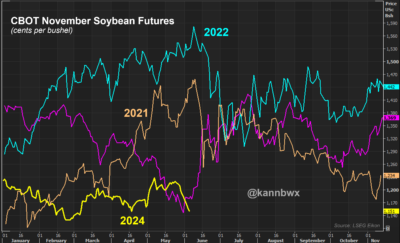
In 2022, November soybeans experienced maximum seven-session declines of around 7%, occurring multiple times. Large money managers, who had been bullish for three years, were nearly flat in CBOT soybeans heading into June.
Money managers held a record net short position in early March 2024 before a record round of short covering in early May due to concerns over the Brazilian crop. As of May 28, money managers’ net short of 14,218 CBOT soybean futures and options contracts was the lightest since the start of the year.
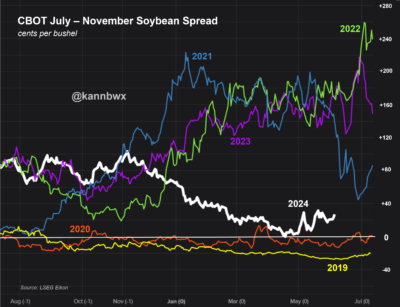
This year differs from the past three due to the relatively low premium of old-crop beans versus new-crop, indicating a less urgent immediate need for supplies. Nearby July beans are trading around 27 cents per bushel above November beans.
In April, this spread briefly turned negative for the first time since 2020. In contrast, the July-November inverse was between $1.50 and $1.90 at the start of the last three Junes. Early June 2019 saw the largest carry, close to 30 cents per bushel.
China plans to increase its wheat stockpile by purchasing more from domestic producers as the world’s top producer and consumer of wheat seeks to secure supply amid recent weather-related damages affecting global production.
Adverse weather conditions have impacted crops in Russia, the world’s largest wheat exporter, and both drought and excessive rains have threatened yields in the European Union. These disruptions have raised concerns about lower global supplies in the latter half of 2024, a crucial period for production and marketing.
Wheat buyers in Asia, Africa, and the Middle East—regions that collectively account for two-thirds of global wheat imports—have been caught off guard with limited supply following the weather disruptions that unexpectedly drove prices up since April.
China’s state-owned agricultural stockpiler, Sinograin, announced on Wednesday (June 5) that it and its affiliated units will increase purchases of wheat produced in 2024 from major regions for its reserves, having already started buying in some areas.
In recent months, Chinese buyers have canceled wheat shipments from the U.S. and Australia due to price fluctuations.
Additionally, in January, Sinograin announced plans to increase its purchases of domestic corn.
This year, China, the world’s largest grain importer, significantly expanded its budget for stockpiling grains and edible oils by 8.1% and implemented its first food security law aimed at achieving “absolute self-sufficiency” in staple grains.
A South Korean importer has reportedly purchased approximately 65,000 metric tons of animal feed corn from South America in a private deal made on Wednesday, according to European traders.
The purchase was made from trading house Posco at an estimated price of $242.99 per ton, including cost and freight (c&f).
The importer is believed to be the Korea Feed Association’s Incheon section, also known as the Feed Buyers’ Group.
The corn is expected to arrive in South Korea around October 10, with shipment from South America scheduled between August 1 and August 31.
These reports are based on trader assessments, and further estimates of prices and volumes may be updated later.
Additionally, South Korea’s Major Feedmill Group is said to have purchased an estimated 68,000 tons of animal feed corn in a deal on Wednesday, according to European traders.
Japan’s Ministry of Agriculture, Forestry and Fisheries (MAFF) has purchased a total of 103,767 metric tons of food-quality wheat from the United States, Canada, and Australia in a regular tender that closed on Thursday.
As the world’s sixth-largest wheat importer, Japan tightly controls its wheat imports, the second most important staple after rice. The country typically issues tenders three times a month to buy the majority of the grain for milling.
Details of the Purchase (in metric tons):
| COUNTRY | TYPE | QUANTITY |
|---|---|---|
| U.S. | Hard Red Winter (Semi Hard) | 31,600 |
| Canada | Western Red Spring (min. 13.5% protein) | 25,197 |
| Canada | Western Red Spring (min. 13.5% protein) | 24,510 |
| Australia | Standard White (West Australia) | 22,460 |
Shipments:
-
- U.S. and Canada: Loading between August 1 and August 31
- ** Australia: Loading between September 1 and September 30
Tunisia’s state grains agency has issued an international tender to acquire approximately 50,000 metric tons of soft milling wheat and around 75,000 metric tons of barley. The origin is optional, with the deadline for price offers set for Friday, June 7.
Maritime labor unions in Argentina declared on Thursday that they would halt all port activities for 48 hours, affecting the country’s primary agricultural export hub in the Rosario region. This brief strike was suspended following government-ordered talks between workers and companies.
Despite experiencing adverse weather in May, Ukraine has maintained its grain harvest forecast for 2024 at 52.4 million metric tons. Acting Agriculture Minister Taras Vysotskyi announced on Thursday that any review of this forecast would not occur before July.
Russia might reduce the range of its grain exports in the upcoming season because of crop problems, which could lead to a stronger focus on traditional markets. During the current season, Russia has been active in grain markets like Mexico, Indonesia, and Vietnam, which are usually dominated by other exporters.
Chicago wheat prices dropped for the seventh consecutive session on Thursday, hitting their lowest point in almost four weeks due to the progressing US harvest. This shift overshadowed concerns about adverse weather in Russia. Soybeans and corn, on the other hand, rebounded after reaching multi-week lows on Wednesday, driven by favorable US crop conditions.
Algeria’s OAIC purchased 840,000 metric tons of milling wheat in an international tender, with prices between $279 and $279.50 per metric ton C&F. The wheat, expected from the Black Sea region, includes Ukraine, Romania, Bulgaria, and possibly Russia. This acquisition is part of Algeria’s strategy to ensure adequate wheat supplies.
source: https://www.xm.com/research/markets/commodities/reuters/algeria-wheat-purchase-seen-at-810000840000-t-traders-say-53853915
Jordan’s state grain buyer issued an international tender to purchase up to 120,000 metric tons of milling wheat after making no purchase in a previous tender. The new tender, set for June 11, aims to secure wheat supplies from various optional origins to meet domestic needs.
source: https://www.xm.com/research/markets/commodities/reuters/jordan-tenders-to-buy-up-to-120000-t-wheat-traders-say-53853816
Egypt’s General Authority for Supply Commodities (GASC) purchased 470,000 metric tons of wheat in an international tender. The procurement includes 180,000 tons from Romania, 120,000 tons from France, 120,000 tons from Ukraine, and 50,000 tons from Bulgaria. This diverse acquisition aims to secure Egypt’s wheat supply.
source: https://www.zawya.com/en/markets/commodities/egypts-gasc-buys-470-000-mt-of-wheat-in-tender-pprxmg10
Ukraine has experienced a prolonged absence of rain in May, worsening crop conditions, though the lack of extreme temperatures has prevented critical damage. Despite the dry spell, the country’s agricultural output remains stable, avoiding severe deterioration. Continuous monitoring of weather conditions is essential for crop recovery hopes.
Russia’s Sovecon agricultural consultancy has reduced its 2024 wheat crop forecast to 80.7 million metric tons, down from the previous estimate of 82.1 million metric tons, due to severe frosts. Earlier in March, the forecast was 94 million metric tons. The harsh spring frosts have significantly affected wheat yield expectations, prompting a more cautious outlook for the year’s production.
Chicago wheat prices remained steady after hitting a two-week low, as concerns about weather-related damage to Russian crops eased. Despite the price fluctuations, international demand for wheat remains robust, with significant purchases from Algeria and Egypt. Soybean prices increased on the estimated extent of damage due to flooding in Brazil affecting crop yields, while corn prices slightly declined. Brazil’s floods have notably impacted global soybean markets, highlighting the ongoing influence of weather on agricultural commodities.
source: https://www.xm.com/research/markets/commodities/reuters/wheat-flat-after-touching-twoweek-low-with-eyes-on-russian-crop-53854040
