After challenging their yearly high a month ago, November soybean futures on the Chicago Board of Trade fell for the seventh consecutive session on Wednesday. This decline began shortly after large speculators moved from short positions to nearly flat.
June often sees new-crop November soybeans hit yearly highs, but it can also bring sharp sell-offs. This year, the selling streak has started earlier than in recent years, despite U.S. farmers still needing to plant 20% of their soybean crop.
The last instance of new-crop soybean futures experiencing seven or more consecutive sessions of decline within the year of expiry was in March 2023, with a 13-session streak—the longest in at least 50 years. Before that, there was a nine-session downturn in January 2020.
Over the past seven days through Wednesday, losses totaled 5.7%, with November soybeans settling at $11.50-1/2 per bushel, their lowest since April 18 and the lowest for that date in four years. Late May saw new-crop beans trading above 2023 levels.
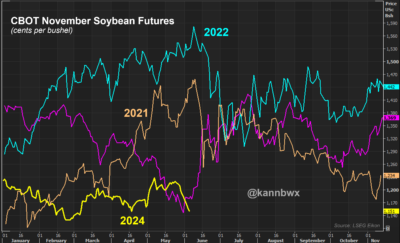
In 2022, November soybeans experienced maximum seven-session declines of around 7%, occurring multiple times. Large money managers, who had been bullish for three years, were nearly flat in CBOT soybeans heading into June.
Money managers held a record net short position in early March 2024 before a record round of short covering in early May due to concerns over the Brazilian crop. As of May 28, money managers’ net short of 14,218 CBOT soybean futures and options contracts was the lightest since the start of the year.
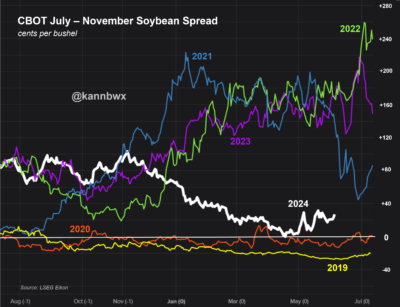
This year differs from the past three due to the relatively low premium of old-crop beans versus new-crop, indicating a less urgent immediate need for supplies. Nearby July beans are trading around 27 cents per bushel above November beans.
In April, this spread briefly turned negative for the first time since 2020. In contrast, the July-November inverse was between $1.50 and $1.90 at the start of the last three Junes. Early June 2019 saw the largest carry, close to 30 cents per bushel.